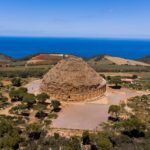
Larendon Tomb
General Pierre Gustave Toutant Beauregard commissioned this unique tomb for his cherished daughter, Laure Beauregard Larendon (1850-1884). General Beauregard achieved immortality as the officer who ordered the first shots fired at Fort Sumter that began the Civil War. His daughter is immortalized by this one-of-a-kind tomb. The tomb in which Laure is spending eternity with her husband and two children was built in 1885 of dark Belgian limestone. The design is Moorish with lobed horseshoe arches and a modified dome crowned with an Eastern Orthodox cross. The somber mood of the structure is enlivened with a circular stained glass window set into one of the arches.
Read More»Satterwhite Monument
Dr. Preston Pope Satterwhite hired famed Philadelphia architect, Horace Trumbauer, to design a monument for his wife, Florence Brokaw Martin Satterwhite, who died in 1927 at the age of 61. Trumbauer based his design on the Classical Revival Temple of Love constructed by French architect Richard Mique (1728-1794) for Marie Antoinette in the gardens of the Petit Trianon at Versailles. Mique based his design on the Roman Temple of Vesta at Tivoli, built in the first century BC.
While Trumbauer worked with B.A. & G.N. Williams, stone contractors in New York City, on the fabrication of the Tennessee marble monument, Dr. Satterwhite busied himself with the selection and preparation of the site. He selected a 26,343 square foot site at Cave Hill which he purchased for $50,000. Then he hired Wadley and Smythe, landscape contractors, of New York City, to prepare the site. Wadley and Smythe promptly ordered four freight cars of plantings, which arrived in Louisville in the spring of 1928. On June 18th, 1928, the monument was officially declared finished.
Florence Brokaw Martin Satterwhite was born into a high society family. The Brokaw family had done well as clothiers and provided young Florence with a taste of the finer things in life. Her first marriage to Standard Oil Company executive James E. Martin ended when he died tragically in 1905 at age 59. He and his son were racing through New York City’s streets when his car overturned. Florence inherited a considerable estate.
In 1908 she married Dr. Satterwhite. They also lead a lavish lifestyle, dividing their time between New York and Palm Beach.
Although the Satterwhites did not live in Louisville, Dr. Satterwhite, like his father and grandfather, studied medicine in Kentucky. After his studies, he set up his surgery practice in New York. Dr. Satterwhite donated considerable money to the J.B. Speed Art Museum in Louisville and to Cave Hill Cemetery.
Photos and text © Douglas Keister Visit Doug’s Author Page
[address cemetery=”Cave Hill Cemetery” street=”701 Baxter Avenue” city=”Louisville” state=”Kentucky” zip=”40204″]
Mackay Mausoleum
Born in Dublin, Ireland on November 28, 1831, the family of John Mackay soon after emigrated to the United States where young Mackay grew up in the New York City area. His working class roots instilled in him a drive and a work ethic that were instrumental in ultimately gaining him his vast fortune. Business acumen and duty to philanthropy are American traits driving development in the nation through the explosive late 1800’s.
Read More»Brunswig Mausoleum
Lucien Napoleon Brunswig (1854 – 1943) was a French emigre who spent his first years in the United States in Fort Worth, Texas working as a druggist. He combined his knowledge of pharmaceuticals with business acumen to create an empire that ensured financial rewards for himself and his successors.
- Early Experiences in the United States
- Philanthropy and Continued Success
- Coming Home: Lucien Napoleon Brunswig’s New Orleans Legacy
- Metairie Cemetery: Jewel of the Crescent City
Early Experiences in the United States
Lucien Brunswig arrived in Fort Worth, Texas from Monmedy, France in the late 1870s. After having established himself as a druggist in North Texas, Brunswig relocated to the Franco-friendly metropolis of New Orleans where he met and married Annie Mercer. The marriage produced a son, Lucien Mercer Brunswig, and daughter, Annie. While in New Orleans, Brunswig began to spread his business wings when he founded a pharmaceutical distributing company.
Lucien Mercer Brunswig died tragically just before his 10th birthday. Only one month later, Mrs. Annie Mercer Brunswig also died. Some years after both of these losses, Brunswig left New Orleans for Los Angeles, California. While in L.A., Brunswig became a partner in a local drug company. Brunswig also remarried while in Southern California. Ironically, Marguerite Wogan was a widow who had also previously lived in the New Orleans area.
Philanthropy and Continued Success
As his company continued to grow, Brunswig set his sights on returning the fruits of his success to the community. The School of Pharmacy at the University of Southern California was constructed thanks entirely to an endowment made by Brunswig to the school. Brunswig also selected smaller local endeavors to support as he continued to enjoy business success. In 1907, Brunswig bought his partner out and renamed the business to the Brunswig Drug Company. He also expanded into San Diego, Tucson, and Phoenix. At one point, and for a long period, Brunswig’s company was the city of Los Angeles’ largest wholesale drug supplier.
During World War I, the 63 year old Brunswig traveled back to France for eight months. As a representative of the ‘Friends of France’, Brunswig crafted essays detailing the effects of the war on his native France, including the scarring damage of battle, and efforts of reconstruction. Additionally, Brunswig wrote articles that highlighted prominent individuals and organizations.
Once back in Los Angeles, Brunswig continued his outreach efforts by founding the Cercle Catholique Francais, a volunteer organization aimed at providing assistance to recently arrived French immigrants. These type of fraternal organizations were very popular among immigrants in the late 1800s and early 1900s.
Despite mergers and name changes, the company founded by Brunswig is still in existence today. Upon his death, the company joined the Bergen Drug Company to become Bergen-Brunswig. In 2001, Bergen-Brunswig merged with AmeriSource Health Corporation and changed its name to AmerisourceBergen.
Coming Home: Lucien Napoleon Brunswig’s New Orleans Legacy
The Brunswig Mausoleum is in the famed Metairie Cemetery, which is located near New Orleans’ Garden District. Borrowing architectural design influences that date back to the time of the pharaohs, the Brunswig Mausoleum is a pyramidal structure similar to the Cimitero Monumentale in Milan, Italy. As Douglas Keister notes, “These pyramids are usually found with smooth granite sides, a sphinx and some sort of human figure.” The human figure at the Brunswig Mausoleum is a woman carrying a libation urn.
Because the sphinx is regarded as pagan architecture, most designers felt compelled to include a Christian symbol. However, it appears the Brunswig Mausoleum defies that custom, maintaining an ancient Egyptian style throughout.
Interred with Lucien Napoleon Brunswig are his first wife, Annie, their daughter Annie Brunswig Wellborn and her husband, and Henrietta Rosalie Brunswig, who is believed to be the first born daughter from Lucien’s second marriage.
Metairie Cemetery: Jewel of the Crescent City
The Metairie Cemetery is named for the road on which it is located and the Bayou Metairie. Visitors might think the cemetery is located in the nearby suburb of the same name, but it is actually located within New Orleans city limits. The city’s elevation just below sea level has required above-ground interment of deceased residents for generations. Throngs of visitors to New Orleans tour the city’s cemeteries and mausoleums because they are so unique.
Metairie Cemetery is widely regarded as having the largest collection of elaborate marble tombs and funeral statuary in the city. Several notable New Orleanians are interred at Metairie Cemetery. Among them are:
- Ruth Fertel, the founder of Ruth’s Chris Steak House
- Jim Garrison, former D.A. of New Orleans and subject of the Oliver Stone film JFK
- Mel Ott, Hall of Fame major league baseball player
- Louis Prima, legendary band leader
Like many individuals of this time, Lucien Napoleon Brunswig was a self-made man who sought and achieved a level of success experienced by a select few. Brunswig also shared his wealth with community by distributing his fortune among groups and organizations with which he felt a kinship. The gifts, endowments, and grants are as much a lasting legacy as the impressive Brunswig Mausoleum in which he is interred.
Photos and text © Douglas Keister Visit Doug’s Author Page
[address cemetery=”Metairie Cemetery” street=”5101 Pontchartrain Boulevard” city=”New Orleans” state=”Louisiana” zip=”70124″]
Woolworth Mausoleum
F.W. Woolworth
April 13, 1852 – April 8, 1919
Franklin Winfield Woolworth developed a sales formula based on attractive displays and reasonable fixed prices. He cunningly realized that pricing articles for sale in increments of 5 cents and 10 cents, which were the most commonly used coins at the time, encouraged sales. Woolworth found that these business practices encouraged impulse buying and generated increased sales and revenues. By the time of his death, there were over 1000 of his “five and dime stores”. F.W. took his own frugality a little too far: he died of septic poisoning because he didn’t want to pay to see a dentist. Also entombed in the mausoleum is the much-married and terribly unhappy Barbara Hutton (1912-1979) known as the “Poor Little Rich Girl,” who was the granddaughter of F. W. Woolworth and heir to his multimillion dollar estate.
The Barre granite mausoleum was built by Farrington, Gould and Hoagland in 1921. The mausoleum is constructed in the Egyptian Revival style with two Greek sphinxes (Egyptian sphinxes are male) flanking the entrance steps. Two columns with horizontal banding and palm capitals frame the recessed entrance. The exterior walls are slanted in at about 70 degrees since Egyptian architecture relies on massive stone and angles rather than arches to create strength. to create Both the entablature and the lintel above the entrance feature relief carvings of a winged solar disc, an icon that Egyptians believe offered protection to the dead. The mausoleum has a cavetto cornice (curved with arch) and roll molding at its corners and where the façade meets the entablature. The bronze door was designed by sculptor Julius C. Loester and cast by the Roman Bronze Company The interior was renovated by the family in 1941, with Italian marble and large double marble sarcophagus by Evans of Boston. The landscape design by Brinley and Holbrook, who executed plans for the New York Botanic Garden in 1920, “employed a formal scheme to accentuate the solidity and scale of the building, while successfully screening a vista spotted with many imposing mausoleums.”
Photos and text © Douglas Keister Visit Doug’s Author Page
[address cemetery=”The Woodlawn Cemetery” street=”East 233rd Street” city=”Bronx” state=”New York” zip=”10470″]
Army of Tennessee Tumulus and Pierre Gustave Toutant Beauregard
Riding astride his noble steed, Fire Eater, General Albert Sidney Johnston, Confederate States of America, directs his troops to charge the Federal lines on the first day of the Battle of Shiloh. Seconds later he was felled by a Yankee bullet, ending his short, but illustrious, career. Now, he is frozen for all time directing automobiles, trucks and motorhomes speeding toward downtown New Orleans on Interstate 10. The General and his steed crown the Benevolent Association, Army of Tennessee, Louisiana Division tumulus in Metairie Cemetery.
Read More»