Fleischman Mausoleum
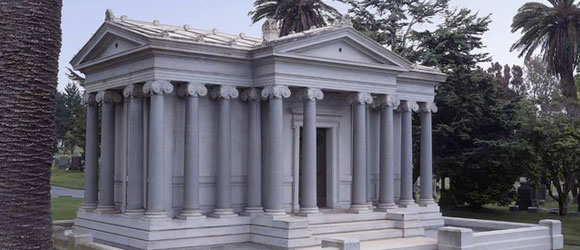
William Salway, the superintendent of Spring Grove Cemetery, designed this miniaturized, peristyled Doric Temple, reminiscent of the Parthenon, for the Fleischman family in 1913. Salway, who was trained as an engineer and landscape gardener in England, had taken the job of superintendent in 1883 following the death of former superintendent, Adolph Strauch. Strauch came to Spring Grove in 1854 and established the “Landscape Lawn Plan” of cemetery design, and established Spring Grove as one of the most attractively landscaped cemeteries in the country, a distinction that remains to this day.
In designing the Fleischman mausoleum, Salway combined neoclassical architecture with naturalism to to create a rustic, but ordered effect. The combination of the white temple (inspired by the 1893 World’s Columbian Exhibition in Chicago) the plantings and the lake creates a picture much like the famous English garden at Sourhead.
W.H. Harrison, president of the Harrison Granite Company in New York, erected the mausoleum using 5000 cubic feet of Barre, Vermont granite. The walls are 18 inches thick. Recessed into one of them is a well secured stained glass window depicting the Three Fates.
Photos and text © Douglas Keister Visit Doug’s Author Page
[address cemetery=”Spring Grove Cemetery” street=”Spring Grove Ave” city=”Cincinnati” state=”Ohio” zip=”45232″]
Egan Tomb
It appears the Egan family tomb has fallen into disrepair and is gently crumbling into the Earth, but in fact the tomb is in quite good repair and should stand for many years to come. The Egan tomb, built in the late 1800’s of Tennessee marble, is one of the most unique and creative replica tombs in the world. Often referred to as “the ruined castle” its design is taken from a little chapel on the family’s estate in Ireland that had been burned, vandalized and lay in ruins.
The design has been attributed to Pierre Casse, who skillfully carved the marble to make it appear chipped, cracked and broken. To complete the illusion, the slab containing the names of the fallen Egan’s (on the floor of the tomb, covering the underground crypts) also appears to be cracked. Perhaps the tomb is a representation of life cut short: it contains the remains of two young Egan men who died in the Civil War, 24 year old Henry Egan who was killed at Amelia Springs, Virginia, on April 6, 1865, and 24 year old, Yelverton Egan, who was killed at the Battle of Sharpsburg (Antietam) on September 17, 1863. The inscription above the Gothic arch, “Sic itur ad astra ”(Thus is accomplished the journey to the stars), is from Vergil, Book ix, line 641 written in 19 B.C.
Photos and text © Douglas Keister Visit Doug’s Author Page
[address cemetery=”Metairie Cemetery” street=”5101 Pontchartrain Boulevard” city=”New Orleans” state=”Louisiana” zip=”70124″]
Vaccaro Mausoleum
Three Vaccaro’s (Joseph, Felix and Luca) have mausoleums on Metairie Avenue, but the Luca Vaccaro mausoleum, built in 1925, is the most interesting. It is a personal interpretation of the Tower of the Winds in Athens. The Tower of the Winds c. 40 BC., an octagonal building designed by Andronicus Cyrrus, served as a weather guide and water clock. On each of the 8 frieze panels were carvings of personified winds. The structure in Athens had three porticos (one round and two square) attached to its sides. For the Vaccaro mausoleum, sculptor Theodore Bottinelli, carved some frieze panels as they appear in the Athenian temple, but for other panels he chose more funerary themes, such as a young man holding a torch and an hourglass and a young woman playing a harp.
Photos and text © Douglas Keister Visit Doug’s Author Page
[address cemetery=”Metairie Cemetery” street=”5101 Pontchartrain Boulevard” city=”New Orleans” state=”Louisiana” zip=”70124″]
Berwind Mausoleum
The Berwind mausoleum is a remarkably authentic adaptation of the Tower of the Winds in Athens. The only difference is the Berwind mausoleum is minus the porticos found on the original. The mausoleum sports eight frieze panels, each carved to represent one of the personified winds. In the center of the photograph, above the entry is Kaikias, the Northeast Wind; on the right, holding a oil lamp is Boreas, the North Wind and on the left holding a splay of flowers is Apeliotes, the East Wind.
The Tower of the Winds in Athens was designed to measure time by means of a water clock inside the structure and a sun dial mounted on the outside. The Berwind mausoleum, by contrast, houses only Berwinds.
The Berwind mausoleum was designed by architect Horace Trumbauer, who also designed the Berwind family’s estate, The Elms, in Newport, Rhode Island. Horace Trumbauer (1876-1938), is buried in a sarcophagus in another section of West Laurel Hill. Trumbauer was a noted architect of the early twentieth century. His buildings in Philadelphia, New York, Newport, Washington D.C. and Grosse Point, Michigan, were frequently modeled after European structures and designs.
Edward J. Berwind (1848-1936) is best described as a capitalist whose fortune was made in the coal business. As with most Capitalists, he had a number of diversified businesses. When he died in 1936, his estate was valued at 31 million dollars.
Photos and text © Douglas Keister Visit Doug’s Author Page
[address cemetery=”West Laurel Hill Cemetery” street=”Lower Merion” city=”Bala Cynwyd” state=”Pennsylvania” zip=”19004″]
Dexter Chapel Mausoleum
It took four years (from 1865 to 1869) for Cincinnati architect James Keyes Wilson to design this Gothic Revival combination chapel and mausoleum for the Dexter brothers—the chapel is above and the crypts are below. Although the Dexter brothers wanted a structure that was reminiscent of Sainte Chapelle in Paris, Wilson may also have been inspired by Chinchester Cathedral in England. With its flamboyant design and massive flying buttresses, it is considered one of the most beautiful buildings in the Cincinnati Area.
When it was finished in 1869, the Dexter mausoleum had the only flying buttresses in the Cincinnati area. These architectural wonders are fashioned to give buildings extra strength by transmitting the thrust of a vault or a roof from the upper part of a wall to an outer support, known as a buttress. When the buttresses are open, as seen in the Dexter mausoleum, rather than solid, they are known as flying buttresses.
The $100,000 cost of the mausoleum was quite extravagant for its time, but it has long been a centerpiece for Spring Grove Cemetery. The structure has unfortunately been plagued with structural problems almost from the beginning. The sandstone walls were once covered with ivy, which contributed to its decay. Many of the turrets, crockets and pinnacles have deteriorated and fallen to the ground.
Below the chapel area of the Dexter mausoleum are the crypts. Like the rest of the Dexter mausoleum, the crypts are made out of sandstone. Sandstone, especially if it is installed at a certain angle, tends to “melt” over time. The crypts in the Dexter mausoleum are certainly “melting” and appear quite ghoulish. The rear of the crypt area is illuminated by a shaft, which reaches to the upper level chapel behind the altar. The shaft space was intended to contain an elevator for lowering caskets into the crypts, but was never installed. Despite periodic attempts at restoration, it may have to be torn down.
Photos and text © Douglas Keister Visit Doug’s Author Page
[address cemetery=”Spring Grove Cemetery” street=”4521 Spring Grove Avenue” city=”Cincinnati” state=”Ohio” zip=”45232″]
McCan Mausoleum
The David McCan mausoleum with its Gothic Revival form and strong verticality is reminiscent of the Albert Memorial in London’s South Kensington district. The death of Queen Victoria’s consort, Albert, in 1861 was one of the major factors in the popularization of the funerary arts. One of Queen Victoria’s first acts of memorialization of Prince Albert was the construction of the Albert Memorial. Albert died at age 42 following a bout of typhoid fever. According to the Queen, their son, Edward the Prince of Wales brought on Albert’s illness. It seems Edward’s unseemly behavior caused Albert to explode in a fit of rage resulting in irreparable damage to his health. So great was Edward’s sin in Victoria’s mind that she never forgave her son for his behavior. Albert’s death threw the Queen into a mourning frenzy. She wore only black clothing for the remaining 40 years of her life; went to bed every night clutching Albert’s nightshirt; kept a portrait of him on the pillow next to her and went on a memorialization rampage. She had numerous memorials, monuments and buildings constructed in his memory. One of the results of Victoria’s huge influence on culture, (after all, an entire era was named after her) was that erecting showy memorials became the fashionable thing to do.
Photos and text © Douglas Keister Visit Doug’s Author Page
[address cemetery=”Metairie Cemetery” street=”5101 Pontchartrain Boulevard” city=”New Orleans” state=”Louisiana” zip=”70124″]
Cogswell Monument
The Cogswell monument is a 70-foot granite obelisk crowned with a ten inch rose crystal star and surrounded by a number of curious carved stone sculptures. It is sited so that it is visible from much of the hilly cemetery. The pieces comprising the monument were carved on the East coast, and then loaded on 38 freight cars for their shipment to California. Historical records state that the 329-ton shipment was the “heaviest shipment ever made at one time across the country”.
After arriving at the terminus of the railroad in Oakland, the 30-ton obelisk was placed on a special wagon shipped from the east. Try as they might, the 24 horses couldn’t get the wagon to budge. Eventually, a combination of house moving equipment and a traction engine inched the obelisk up Cemetery Avenue and to the Cogswell plot. After all the pieces arrived at the site, crews of workmen took to the task of assembling the monument. In August of 1887, viewing the progress of the erection of the Cogswell Monument became a popular outing for many of Oakland’s residents.
Henry Daniel Cogswell (1820-1900) studied and practiced dentistry in Providence, Rhode Island, until his office was destroyed in a fire. Then, in 1849, like so many young men of the time he set sail for California. He sold goods in California’s Mother Lode mining region, but soon returned to San Francisco to set up his dental practice. In 1851, just a few months before his wife arrived from the East, his dental office fell victim to one of one of San Francisco’s many fires.
Cogswell eventually found his fortune as a land speculator; founded Cogswell Dental College, Cogswell Polytechnic Institute and gave considerable funds to the University of California. Cogswell was an ardent foe of demon rum and to that task he erected a number of water fountains in cities across the United States. These water fountains featured a bronze statue of a man that looked amazingly like Cogswell with a temperance pledge in one hand and a water goblet in the other.
Visitors to the Cogswell Monument in Mountain View Cemetery may wish to note the four figures flanking the obelisk: Faith, Hope, Charity and Temperance (she’s the one with the water goblet in her hand).
Photos and text © Douglas Keister Visit Doug’s Author Page
[address cemetery=”Mountain View Cemetery” street=”” city=”Oakland” state=”California” zip=”94611″]
Lacosst Monument
Eugene Lacosst (1854 – 1915) was one of the very colorful individuals that gave personality to the city of New Orleans. Early in his career, Lacosst was a local hairdresser frequented by many women from the top families in New Orleans. These social connections were a boon in an age of parlor parties. At these occasions, Lacosst, known for his unmatched talent of whistling, was often called upon to regale those in attendance with his warbling.
- The Surprise of Wealth
- The Lacosst Legacy: A Stunningly Styled Monument
- Metairie Cemetery: Jewel of the Crescent City
- A New Orleanian for Eternity
The Surprise of Wealth
While successful in his business, both socially and professionally, Lacosst amassed a fantastic wealth thanks to his wise stock market speculation in the late 1800’s. It was this new wealth that permitted Lacosst to earmark $60,000 for the construction of a stunning mausoleum that is perhaps only rivaled by earlier constructions in Europe.
One of the defining characteristics of New Orleans is its elevation below water level. The need to protect the deceased from flooding has led to the creation of elaborate mausoleums in many signature cemeteries and memorial parks. The Lacosst Mausoleum is a testament to the design and craftsmanship available to those of means.
The Lacosst Legacy: A Stunningly Styled Monument
Located in the Metairie Cemetery near New Orleans’ famed Garden District, the Lacosst Mausoleum is an homage to a memorial for a prominent Cardinal at the Church of Santa Croce in Florence, Italy. New Orleans-based architects Burton & Bendernagel created a perfect Renaissance Revival-style monument in the Lacosst Mausoleum.
At the center of the structure is a pedestal holding the sarcophagus. This design element is known, according to Douglas Keister, as an exedra. An exedra is a rectangular or semi-circular recess with raised seating. The entire structure is crafted from cream-colored Alabama marble, which was excavated and transported to the workshops of Albert Weiblen, the manufacturer of Burton & Bendernagel’s vision.
Construction of the Lacosst Mausoleum was performed and completed in the midst of World War I. The wartime effort resulted in severe shortages of both labor and material. The fact the mausoleum was able to be created was, as Keister notes, “as much a testament to Lacosst’s wealth as it is to the craft of the stone carvers.”
Artisans were brought in from Italy to gently and expertly mold the raw Alabama marble into the stunning structure it is today. The architects were so committed to the design that they insisted only the finest pieces of excavated marble be used in the final construction. After a process of constant quality assurance, the production team discarded enough marble that over two dozen other mausoleums could have been constructed just from the rejected material.
Metairie Cemetery: Jewel of the Crescent City
The Metairie Cemetery is named for the road on which it is located and the Bayou Metairie. Visitors might think the cemetery is located in the nearby suburb of the same name, but it is actually located within New Orleans city limits. The city’s elevation just below sea level has required above-ground interment of deceased residents for generations. Throngs of visitors to New Orleans tour the city’s cemeteries and mausoleums because they are so unique.
Metairie Cemetery is widely regarded as having the largest collection of elaborate marble tombs and funeral statuary in the city. Several notable New Orleanians are interred at Metairie Cemetery. Among them are:
- Ruth Fertel, the founder of Ruth’s Chris Steak House
- Jim Garrison, former D.A. of New Orleans and subject of the Oliver Stone film JFK
- Mel Ott, Hall of Fame major league baseball player
- Louis Prima, legendary band leader
A New Orleanian for Eternity
Eugene Lacosst represented that distinctly idiosyncratic combination of complexity and curiosity for which New Orleans is known. Born a servant and died a sire, Lacosst specified in his will that his monument should be designed only to accommodate two caskets: his own and his mother’s.
Photos and text © Douglas Keister Visit Doug’s Author Page
[address cemetery=”Metairie Cemetery” street=”5101 Pontchartrain Boulevard” city=”New Orleans” state=”Louisiana” zip=”70124″]
Huck Mausoleum
Perhaps its fitting that the name of the architect who designed the Huck mausoleum has been lost to the ages, because the building manages to look like an alien space vessel from a Star Wars movie. Then again, Chicago has a long tradition of creative and innovative architecture, so what better place to try some experimentation than a cemetery, where few critics ever venture.
Cemetery records indicate the Huck mausoleum was built in 1915, probably by the wife of Louis Carl Huck, on a plot Huck purchased in 1888. Besides Mr. and Mrs. Huck, the mausoleum contains the remains of three infants who were moved here from other locations. Huck owned the Sheridan apartment building at the corner of LaSalle and Carl streets in Chicago.
Photos and text © Douglas Keister Visit Doug’s Author Page
[address cemetery=”Graceland Cemetery” street=”4001 North Clark Street” city=”Chicago” state=”Illinois” zip=”60613″]