Queen of Heaven Mausoleum
Gothic Revival meets the 1950’s in this sandstone fortress located 15 miles west of downtown Chicago. The original architectural renderings, drawn in 1954 called for a much sleeker structure and did not include the multi-crocketed finials on the tower, but traditionalists prevailed and the towers and other ornamentation were added. After its construction in 1956, Queen of Heaven became quite popular among Catholics desiring above ground burial. By 1961, a new section, Queen of Angels was added and by 1964 came the final stage, Queen of All Saints. The mausoleum triplex contains over 33,000 crypts, 9000 of which remain to be filled.
Queen of Heaven mausoleum, the world’s largest Catholic mausoleum, contains a stunning display of artwork. Within its chapel, hallways and crypt rooms are 217 stained glass windows, dozens of statues, intricate mosaics, exotic hardwoods and 48 types of marble.
The Queen of Heaven chapel, Our Lady’s Chapel, looks like a regular chapel, but flanking the sides of the chapel are crypts. This style of entombment echoes earlier Christian times when church burial was preferred—the closer to the altar the better the chances of being inched toward heaven by the parishioners’ prayers. The large stained glass window in back of the altar commemorates the Coronation of Mary as Queen of Heaven.
Photo and text © Douglas Keister Visit Doug’s Author Page
[address cemetery=”” street=”1400 South Wolf Road, Hillside” city=”Chicago” state=”Illinois” zip=”60162″]
Bourne Mausoleum
Massive and imposing, the Bourne Romanesque Revival mausoleum looks like its here to stay. Ornamentation is almost nonexistent except for an oversized keystone worked into the doorway and a few round sandstone caps that look like stone porthole covers. Hallmarks of Romanesque Revival architecture as seen in the Bourne mausoleum are the heavy buttresses and a rounded arch with a deep reveal forming the entry.
Photo and text © Douglas Keister Visit Doug’s Author Page
[address cemetery=”Mount Auburn Cemetery” street=”580 Mount Auburn Street” city=”Cambridge” state=”Massachusetts” zip=”2138″]
Gould Mausoleum
Architect H.Q. French of New York designed this Ionic peripteral temple mausoleum, reminiscent of the Parthenon, for Jason “Jay” Gould the man who defined the term, “Robber Baron”. French was the designer of a number of elegant tombs, most of them in the Classical Revival style. Unfortunately little is known about French’s life, but he has left behind a legacy of beautiful architecture. To add to the beauty of the Gould mausoleum is a huge weeping birch tree, which was designated one of the “113 Great Trees in New York City” in 1985.
A number of members of the Gould family are entombed in the mausoleum including Gould’s wife, Helen, who died in 1889, and a number of their children. All of the caskets are in wall crypts. Interestingly, Jay Gould’s crypt is soldered closed. Apparently the Gould family didn’t want a repeat of an incident that occurred in 1876 where the body of another millionaire, A.J. Stewart, was stolen from St. Mark’s Cemetery in Manhattan, and his remains were held for ransom. An undisclosed amount of money was paid by Mrs. Stewart for the return of what was presumed to be her husband, (embalming wasn’t an exact science in the 1870’s). Accounts of the day suggest that some of Gould’s enemies on Wall Street had the casket sealed so there was no way he could ever show up to wreak havoc again. The London Times obit summed up Gould’s life best when it declared, “All honor to the greatest money maker of any age or clime. He was less a man than a machine for churning wealth. Napoleon’s combinations were never vaster…. It will be impossible to explain one phase of civilization without a frequent mention of his name.”
Text and photos © Douglas Keister Visit Doug’s Author Page
[address cemetery=”The Woodlawn Cemetery” street=”East 233rd Street” city=”Bronx” state=”New York” zip=”10470″]
Stonehenge Memorial
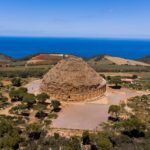
This cenotaph (a monument built to a person or persons whose remains lie elsewhere), was built by noted eccentric Sam Hill, whose own tomb lies nearby, to commemorate 13 young Klickitat County men who gave their lives in World War I. The altar stone was dedicated on July 4th, 1918 and the full structure was completed and dedicated on May 30th 1929. Sam Hill had the structure fabricated out of concrete to resemble how the original megalithic Stonehenge on Salisbury Plain, Wiltshire, England must have appeared ca. 1350 B.C.. Sam Hill’s Stonehenge sits high on a bluff overlooking the Columbia River near Maryhill, Washington.
During a total eclipse of the sun in February,1979, Stonehenge, not surprisingly, became a center of activity. Thousands of people, including members of the New Order of Reformed Druids, gathered at Sam Hill’s concrete creation to witness the moon “eating the sun”. The participants sang and chanted in the darkness until the sun again emerged from behind the moon.
Sam Hill also built a town, (Maryhill) and a museum, (The Maryhill Museum) both named for his wife, Mary, on his isolated property. He was noted for his eccentric ways and although he did not originate the phrase he certainly helped propagate the oft used phrase ‘What the Sam Hill are you doing?!’.
Photo and text © Douglas Keister Visit Doug’s Author Page
[address cemetery=”” street=”” city=”Maryhill” state=”Washington” zip=””]
Stewart Mausoleum
Noted architect, Stanford White, designed this mausoleum for the Stewart family. Although records do not indicate how many monuments and mausoleums White personally designed, his firm, McKim, Mead and White, designed 40 funerary monuments between 1879 and 1919. Most of the firm’s designs are classical in origin and the firm often collaborated with other designers and sculptors to achieve the final product.
White’s rather plain design for the Stewart mausoleum is enhanced by bronze reliefs sculpted by Augustus Saint-Gaudens in 1883. Saint-Gaudens often collaborated with Stanford White. Saint-Gaudens achieved fame as the designer of the United States’ twenty dollar gold piece, often known referred to simply as the “Saint-Gaudens”. The bronze panels Saint-Gaudens crafted for the Stewart mausoleum are very low relief and look as if they have been scratched into the surface. One panel depicts an angel holding a banner or scroll, symbolizing the taking of the inventory of one’s life. The other panel presents an angel holding a long horn, symbolizing the Archangel Gabriel, who signals the heavens of the impending arrival of another soul. The angel is seated on a bench which is inscribed with a biblical verse.
The Stewart family mausoleum contains, among others, David Stewart (1810-1891), who made his fortune in coal and iron mining, and as owner of the Stewart Iron Works in Uniontown, Pennsylvania. In 1830 he married Adelia Smith. They had four children; the oldest, Isabella, later became famous as "Mrs. Jack" Gardner of Boston, founder of the Gardner museum. She opened her “house museum” to the public, but ruled over it like a mother hen. Even in her later years, when she was bedridden, she would call out to imaginary visitors not to touch her treasured works of art.
Photo and text © Douglas Keister Visit Doug’s Author Page
[address cemetery=”Green-Wood Cemetery” street=”Willow Avenue” city=”Brooklyn” state=”New York” zip=”11218″]
Van Ness Parsons Mausoleum
American cemeteries often have a schizophrenic attitude towards Egyptian architecture. While almost all Egyptian architecture has something to do with death and the afterlife, thus making it a perfect fit for the cemetery, it’s pagan origin often raises the hackles of the religious community. Memorial designers often soften the pagan profile of Egyptian forms by adding Christian figures and symbols. The Van Ness Parsons mausoleum is a perfect example of this hybridization. Over the entrance to the mausoleum are vulture wings, a Egyptian symbol for maternal care, but that is softened by statues of an adoring sphinx gazing upon Jochebed holding her son Moses, while another statue portrays Jesus holding a lamb symbolizing innocence. Jesus is known as the Lamb of God. In the distance is another maternal figure that may be a representation of Pharaoh’s daughter finding Moses in the bulrushes, in Egypt.
The most noted occupant of the mausoleum is Albert Ross Parsons (1847-1933), a noted pianist and head of the piano department at the Metropolitan Conservatory of Music. More apropos to the mausoleum, Parsons was also an Egyptologist who wrote the book, New Light From the Great Pyramid: An astronomico-geographical system of the ancients recovered etc. in 1893. Also sharing space in the pyramid is Parsons’ wife Alice Schuyler Van Ness who died in 1931.
Text and photo © Douglas Keister Visit Doug’s Author Page
[address cemetery=”Green-Wood Cemetery” street=”Willow Avenue” city=”Brooklyn” state=”New York” zip=”11218″]
Matthews Mausoleum
John Matthews
1808-January 12, 1870
One of the most effervescent tombs gracing Green-Wood’s grounds is the monument to John Matthews. Its spectacular array of ornamentation looks like it just bubbled out of the ground in a terracotta and marble ooze. And well it should bubble; for John Matthews brought soda water to America. Mathews was born in England. As a teenager he apprenticed in the shop of inventor, Joseph Bramah, where he learned how to make machinery and most importantly learned how to make carbonic acid gas, the essential ingredient for soda water. In 1832 he left England for America and soon set up shop at 55 Gold Street in Manhattan where he began to manufacture carbonating machinery and sell soda water to local retailers.
Matthews’ business took off when he realized he could use marble chips to make soda water and that there was an ample supply thanks to the many construction projects taking place in the booming burg of New York. In fact, there were enough scrap marble chips from the building of nearby St. Patrick’s Cathedral to make twenty-five million gallons of soda water. Matthews’ other advantage over his competitors was his rather ingenious human-safety-valve in the form of an ex-slave named Ben Austen. At the time, safety valves were unreliable and there were frequent explosions. Ben Austen had a large and powerful thumb that he held over the pressure cock. When the pressure blew Austen’s thumb off the pressure cock, the pressure in the tank had reached the desired limit of 150 pounds and the pressurization was stopped. Austen’s thumb was so valuable that when a number of blacks were lynched during the Irish riots during the Civil War, Austen was hidden in a shipping crate to avoid detection. The term, “Ben’s thumb” was part of the jargon in the soda water manufacturing industry, meaning the soda water was at the proper pressure.
John Matthews’ business continued to prosper and he opened up numerous soda fountains, sold soda water, added flavoring to soda water and licensed soda water apparatus. By the time he died, Matthews owned over 500 soda fountains. The Soda Water King’s final resting place is in the form of a catafalque/sarcophagus encompassed in a castrum doloris (Latin for castle of grief) a type of elaborate tomb usually reserved for royalty, Popes and the elite. These tombs are adorned with funerary symbols, allegorical figures and often scenes from the person’s life. The Matthews tomb has the faces of his daughters carved into the gables, his wife (some accounts say it is a statue of grief) seated above him, gargoyles and various woodland animals scampering around the edges. Prostrate and almost melting into his sarcophagus, Matthews looks up at relief panels, which depict events in his life —apprenticing at the shop in England, leaving England for America, pondering the idea of soda water and finally being crowned for his achievements. The area around the Matthews tomb is peppered with the graves of other members of the Matthews family.
The tomb, which was crafted by Karl Muller, won an award as the “Mortuary Monument of the Year” soon after it was built in 1870. However, noted art critic Effie Brower had other words for it. In her 1878 book In Memoriam: Greenwood Leaves she said [it reflected] “the hideousness of morbid taste”.
Photo and text © Douglas Keister Visit Doug’s Author Page
[address cemetery=”Green-Wood Cemetery” street=”Willow Avenue” city=”Brooklyn” state=”New York” zip=”11218″]
Winter Mausoleum
The Winter mausoleum, built in 1930, appears to be an exact duplicate of the Woolworth mausoleum at Woodlawn Cemetery in The Bronx, that was built in 1920. Architect John Russell Pope designed the Woolworth mausoleum. Judging from the similarity between the two mausolea, Pope appears to have been involved with or at least consulted on the Winter mausoleum. With their clean lines and more stylized ornaments, both mausolea are a departure from older forms of Egyptian Revival architecture. The quite buxom sphinxes are derived from Greek architecture, where sphinxes were always female, but other details, such as the vulture wings, cobras and sun are all taken from ancient Egyptian architecture.
The bronze door of the Winter mausoleum is a treasure trove of Egyptian symbols. The most widely known symbol is the “ankh” being held by both male figures. The ankh is a symbol of immortality, often depicted being carried by the Gods. The ankh combines two Egyptian symbols, the T cross, or tau, (the symbol of Osiris) and the oval, (the symbol of Isis). At the top of the door are twin vultures, symbols of maternal care.
Emil Winter (1857-1935), was president of the Workingmen’s Savings Bank and Trust Company in Pittsburgh and was head of a number of metal production companies. He had a large overseas plant in Austria, for processing manganese ore. He was one the founders of the Pittsburgh Steel Company.
As grand as his mausoleum is, it is overshadowed by “Lyndhurst” his opulent home in the Squirrel Hill area of Pittsburgh.
Text and photos © Douglas Keister Visit Doug’s Author Page
[address cemetery=”Allegheny Cemetery” street=”4715 Penn Avenue” city=”Pittsburgh” state=”Pennsylvania” zip=”15224″]
Murphy Mausoleum
The design of the Murphy mausoleum, built of sandstone in 1921, has been attributed to Bernard J. S. Cahill (1866-1944), who designed a number of structures at Cypress Lawn. Cahill chose French Gothic, a style of architecture that emerged in 12th and 13th century French Cathedrals. The term “Gothic” was originally intended as an insult by Italian Renaissance artists. Use of the term implied that Medieval cathedrals, when compared to Renaissance buildings, were so crude that so crude that only a Goth could have produced them. The Goths were Germanic barbarians who had sacked Rome in 410 A.D.. The Goths are closely related another barbaric tribe, the “Vandals”.
Charles Conick designed the stained glass windows of this French Gothic mausoleum. Great height is achieved in the beautifully crafted sandstone interior by the use of rib vaults supported on engaged columns.
The Murphy mausoleum is reminiscent of the Chapel of St. Hubert in the city of Amboise, in the Loire Valley in France. The Chapel of St. Hubert was also used as a model for the Belmont mausoleum at Woodlawn cemetery in the Bronx.
Photos and text © Douglas Keister Visit Doug’s Author Page
[address cemetery=”Cypress Lawn Memorial Park” street=”1370 El Camino Real” city=”Colma” state=”California” zip=”94014″]