Stachura Mausoleum: Last Impressions
- At March 29, 2013
- By Doug Keister
- In Doug Keister's Blog
 0
0

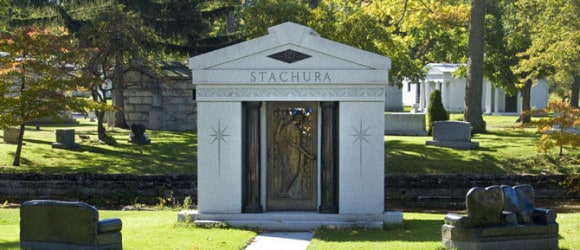
We are all familiar with the saw, “you only have one chance to make a first impression.” Conversely, you only have one chance to make a last impression. A cemetery is, arguably, the best place to make that final statement.
Like many other cemetery explorers, I’m not particularly fond of cookie-cutter flat markers or overly simple plain-Jane tombstones. As a society we have pushed death and cemeteries away, thinking that somehow we’ll lead happier lives denying and defying death. But doing all we can to avoid death makes it harder to truly embrace life. I never feel so truly alive as I do in the midst of a cemetery.
One of my early cemetery excursions took me to a graveyard at the base of Stirling Castle in Scotland. The graveyard was peppered with 17th century tradesmen’s gravestones. These modest markers told me much more than many modern tombs. Carved into the stones were winged skulls telling me that the resident believed in the existence of a soul, (the rise of Scottish Presbyterianism heralded a more promising view of the afterlife) as well as other mortality symbols. More importantly, the stones were often embellished with the tools the person had used in their life. Here were masons and carpenters and weavers and sea captains with the tools of their trade. Those tools made it easier to picture that person even though they had died centuries ago.
Read More»Spring Grove Cemetery and Arboretum Mausoleums
Spring Grove Cemetery and Arboretum in Cincinnati, Ohio is one of the nation’s finest examples of rural garden cemeteries dating to the mid-19th century. Spanning 733 acres, of which approximately 450 are currently developed, Spring Grove is the second largest cemetery in the United States. In 2007, Spring Grove was designated a National Historic Landmark. Originally “Spring Grove Cemetery,” the governing association changed its name to “Spring Grove Cemetery and Arboretum” in 1987 to recognize its extensive collection of native and exotic trees.
Read More»Oakwood Cemetery Mausoleums, Syracuse, New York

Oakwood Cemetery in Syracuse, New York is a 160-acre historic cemetery dating back to 1859. The cemetery was added to the National Register of Historic Places in 1991. Designed by Howard Daniels in 1859, Oakwood Cemetery is an important part of the history of Syracuse, with a number of noteworthy interments, as well as some notable private and family mausoleums.
Read More»New Zealand’s Biggest Cemetery Plans Space-Saving Hillside Mausoleum
- At August 02, 2014
- By mausoleum
- In General Information
- 0

Waikumete Cemetery, the biggest cemetery in Auckland, spans 1.08 square kilometers but is running out of space. A popular place for burials, the cemetery has filled up the majority of its burial plots and mausoleums and is planning to expand to keep up with demand.
Waikumete was established in 1886 and serves as one of the city’s cultural landmarks. The cemetery currently has 59 private mausoleums, the first of which dates back to 1914. Waikumete’s two public mausoleums hold 24 and 96 people, respectively, and patrons are quickly snapping up available spaces.
Read More»Neo-Gothic Mausoleum
- At March 26, 2013
- By Doug Keister
- In Doug Keister's Blog
- 0
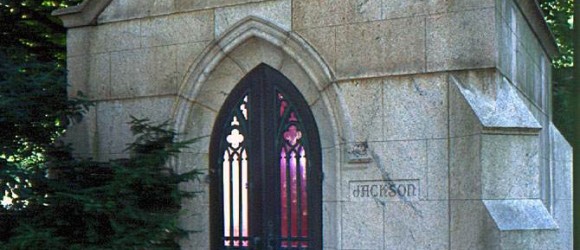
Perhaps no style of architecture is so closely associated with cemeteries as Gothic. Its towers, spires, and flying buttresses are the stuff of ghost stories, dark and stormy nights, and evil sorcerers. The structural advantages of the Gothic style over other types of architecture enabled architects and designers to construct buildings and cathedrals of any size their time and budgets would permit. Because Gothic architecture did not borrow heavily from any of the pagan Classical styles, it is most closely associated with Christianity. It is, in fact, the first purely Christian architecture. Gothic architecture is easy to identify by its vertical emphasis, pointed arches, and heavily ornamented spires.
Think of the great cathedrals in Europe and you’ll get a pretty good fix on the elements of the Gothic style. The style originated in France in the 12th century and lasted another four centuries before dying out in the 16th century. When the Gothic style was reintroduced in the 19th century it was known as Gothic revival.
Read More»